

Nissan Rogue History: How It Has Changed Over the Years
Vehicles like the Rogue are proof that even models from as much as a decade and a half ago can still provide you with fantastic value. The experience of driving any Rogue includes great fuel efficiency, a sleek design, and tech so forward-looking that it holds up against even some of its most modern competitors. If you’re looking for a Nissan Rogue for sale near Urbana, let’s discuss some of the major model updates and summarize what each generation brings to the table. Let’s start the show!
First-Generation Rogue (2008-2015)
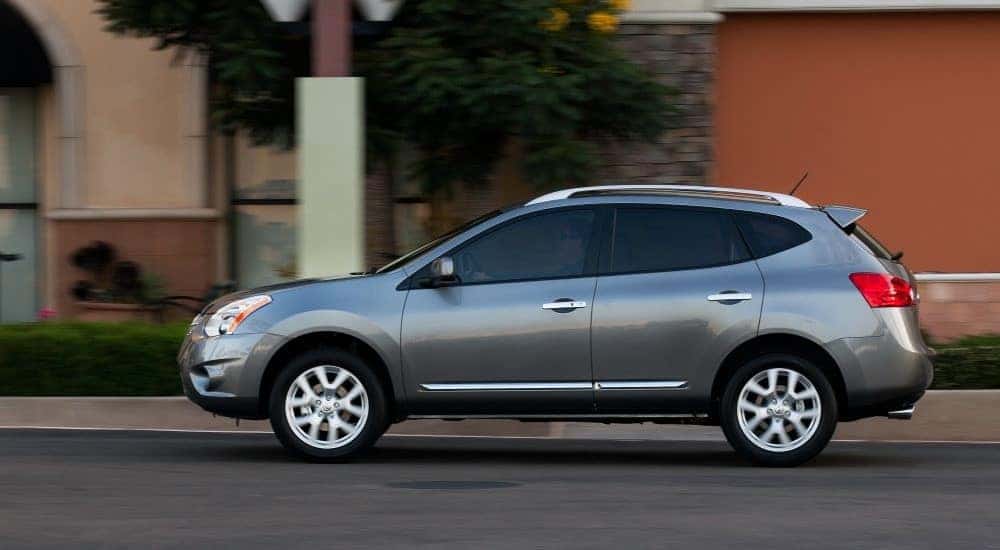
First-generation Nissan Rogue models remain fantastic vehicles in the modern day. Given that some automobiles on the market today have been available for over 50 years, the Rogue hasn’t been around for long. If you’re shopping for a pre-owned Rogue, this is great because there is no shortage of automobiles from the late 2000s still proudly roaming the streets, with many aging gracefully, and the Rogue is no exception. The first of the line was released with the launch of the 2008 Rogue.
The 2008 Rogue set the stage for the next few years, with the 2009 and 2010 models sporting small additions, from optional packages to some aesthetic tweaks. The first-generation Rogue keeps up with many newer vehicles on the road today. In fact, it is equipped with a version of the same powertrain that powered the Rogue until 2021: a 2.5L I-4 engine paired with an Xtronic transmission. In the 2008 Rogue, the 2.5L I-4 engine produces 170 hp and 175 lb-ft of torque, which is only slightly less than the newer versions of this engine.
By providing a fuel-efficient powertrain since the first Rogue release, an older Rogue remains a fantastic pre-owned vehicle if you’re looking for something fuel-efficient to get around Urbana. The 2008 Rogue comes standard with front-wheel drive, which helps to produce EPA-estimated ratings of 24 MPG in the city, 27 MPG on the highway, and 24 MPG combined. All-wheel drive is also available and can achieve an estimated 21 MPG in the city, 26 MPG on the highway, and 23 MPG combined. Thanks to a 15.9-gallon fuel tank, the 2008 Rogue can travel around 366 miles with a full tank if you have all-wheel drive, with an increase to 382 miles if you buy a front-wheel drive model.
Although the official next generation of the Rogue wouldn’t be until the 2014 model, Nissan embedded the tail-end of its first-generation Rogue with some tech that helped modernize it a bit. Some features included with the likes of the 2011 model are still relevant today, and if you’re buying a first-generation Rogue model, it’s not a bad idea to consider a 2011 through 2013 Rogue. With the 2011 Rogue, the media hub finally came with a USB port for data transfer, like playing music, which is something that you’ll still find on even the newest Rogue models today. The updated first-generation Rogue remained in production as the Rogue Select until 2015, two years after the second generation launched.
Second-Generation Rogue (2014-2020)
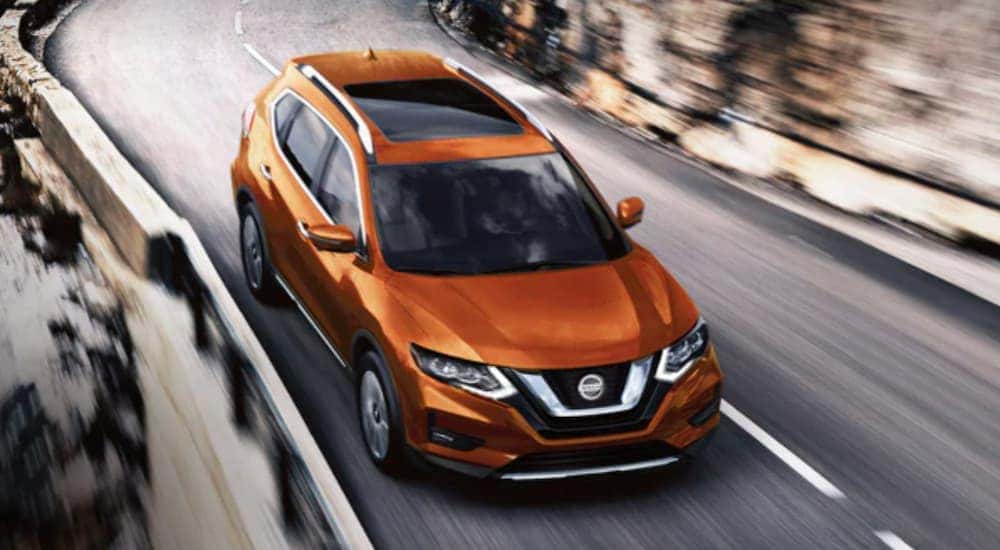
With the second-generation Rogue, more people can come along for the ride. Performance remained unchanged from the first-generation Rogue throughout the second generation, meaning most changes lay elsewhere, such as the addition of a third row of seats. With an available third row, the passenger capacity of the Rogue was increased from five on prior models to up to seven in the 2014 model, letting you bring friends and family around Urbana for a day of fun. Along with the increase in passenger capacity, the second-generation Rogue is a bit roomier.
The first-generation Rogue has a passenger volume of 97.5 cu.ft. and a cargo space of 28.9 to 57.9 cu.ft., depending on whether you keep the back row up or down. With the 2014 Rogue, the passenger volume is increased to 105.8 cu.ft., and the cargo area provides 9.4 cu.ft., 32 cu.ft., or 70 cu.ft. of space, depending on how many rows of seats are folded down. The higher cargo capacity, which is about 21% greater than the prior release, instantly creates a sense of greater versatility for the 2014 Rogue. The Rogue’s changes to the cabin also have other positive effects, like increased head, leg, shoulder, and hip room.
The second-generation Rogue was when we started seeing more advanced and premium tech features show up, many of which are still used in the latest Rogue models. For example, the 2014 Rogue introduced available safety features like Forward Collision Warning, Lane Departure Warning, Moving Object Detection, a Blind Spot Warning System, and an Around View Monitor to give you a 360-degree view around your car thanks to multiple cameras instead of only one located on the rear bumper. The 2016 model added Forward Emergency Braking to complement the Forward Collision Warning, so the Rogue can dynamically come to a halt to prevent potential crashes that the Forward Collision Warning notices.
Advanced safety features coming to the Rogue so early put it miles ahead of the competition, some of which have only begun catching up. Nissan didn’t stop there, however, because the 2018 Rogue was the first to add a standard seven-inch touchscreen infotainment center with Apple CarPlay and Android Auto. Thanks to the 2018 Rogue, the second generation of this beloved SUV solidified its place as the most innovative generation thus far.
Third-Generation Rogue (2021-Present)
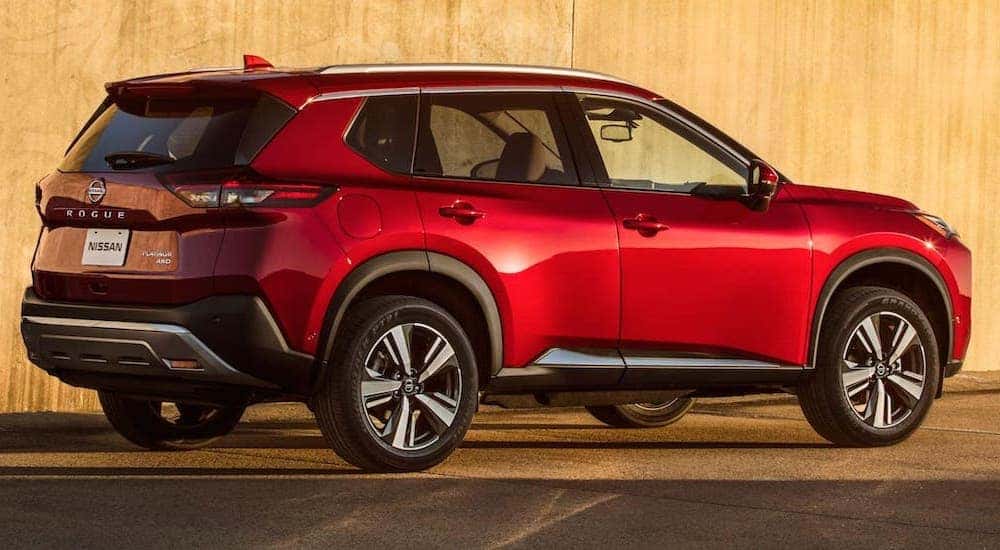
When you think about a brand new Nissan Rogue, you’re thinking about a third-generation model. The third-generation Rogue brings a host of upgrades over the preceding models. There’s a large emphasis on more advanced safety features to keep up with the competition, and this is achieved by utilizing Nissan Safety Shield 360 and Advanced ProPILOT Assist.
In addition to returning features like Forward Collision Warning and Automatic Emergency Braking, there are a host of newcomers. The 2021 Rogue comes standard with Pedestrian Detection, so your Rogue can automatically apply the brakes to avoid striking pedestrians instead of only braking for vehicles––very helpful for the busy streets of Urbana. There’s also advanced Blind Spot Warning and the upgraded sensors allow for features like Rear Automatic Braking and Rear Cross Traffic Alert. Reversing out of a parking space, your driveway, or garage will be safer and easier thanks to your Rogue identifying passing vehicles and stopping accordingly to avoid collisions.
The 2021 Rogue utilizes a 2.5L I-4 engine like its predecessors, but the 2021 model introduces a slight performance bump over previous models. If you buy the 2021 Rogue, you get 181 hp and 181 lb-ft of torque. The 2022 model increased performance again, and this time, it was even more of a substantial upgrade.
With the 2022 Rogue, you’ll find the same powertrain still used in new models, which is a turbocharged 1.5L I-3 engine paired with an improved transmission. Thanks to the new standard powertrain, the 2022 Rogue outputs 201 hp and 225 lb-ft of torque, which is a decent upgrade––18% more horsepower than the first-generation Rogue and 29% more torque. If you consider the initial Rogue models set the stage and the second-generation refined upon it, the third-generation Rogue tied it all together by offering competitive performance to complement the incredible tech the Rogue has consistently been known for since its earliest days on the market.
Is Buying a Rogue the Right Move?
Is buying a Rogue the right move? Yes, buying the Rogue is an excellent idea if you’re an Urbana driver, and as we’ve discussed, even the first-generation Rogue models were ahead of the game in some impressive ways. Whether you buy a first-generation, second-generation, or third-generation Rogue, you’re in a great position for reliable and efficient transportation. The best way to find the right Rogue model is to consider what you want from your SUV and how much you’re willing to spend; then, you can count on a reputable dealership like ours to help you find the perfect match.

0 comment(s) so far on Nissan Rogue History: How It Has Changed Over the Years